Download from Bandcamp
Enter URL of the Bandcamp page below
Achaemenid Cube
Includes unlimited streaming via the free Bandcamp app, plus high-quality download in MP3, FLAC and more.
"Achaemenid Cube" is a work that exists in superposition - that is, it consists of two separate albums, one issued as LSZ and one issued as Limestone Ziggurat, neither of which are considered the original work. They are two sides of the same six-sided object, and yet they are unique and apart from one another. Perhaps, visually, you could consider one the outer surfaces of the cube, and the other the inner surfaces of that same cube. Or you could simply look at it pragmatically, knowing fully my predisposition for overly (and unnecessarily) complex concepts applied to what is essentially just another double album. With that notion in mind, I would counter with the questions: If you have always done things one way, and find a way to do them another way, why would you continue to do things as you always have? Why would you decide to make a change?
My thinking, when working on pieces like "Achaemenid Cube," is relative to the creative process itself, and the machines I have used to explore these ideas in the first place. Both albums originated using the same patch in the same modular system, with the only differences between them being the waveform shape of the oscillators themselves, and yet this is itself such a fundamental alteration that the entirety of the output changes - the same machines, the same connections between them, and only the manner of speech in their electrical communication changed from sinusoidal to consonant. This iteration of "Achaemenid Cube" contains the six Planar Regions in Sine, while the Ziggurat iteration contains the six Planar Regions in Pulse.
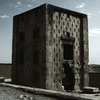
Offered as a visual accompaniment are photographs of two iterations of the same structure, built in two different areas by the Zoroastrian Persians in the distant past. Only educated guesses remain today to tell us what these cuboid structures were intended for - tombs, landmarks, temples of worship? Building a sacred fire? Housing sacred texts? As many reading and listening already know, I often find the remnants of the ancient world enthralling, and it is a continuous source of strangely useful information to spur on the creative act, when I often sit down to work on a modular patch and need only raw inputs of numerators to begin.
The past still exists, as evidenced by these ruins, and it is a remarkable feeling to know that something still standing today can be so old that even the ancient world did not know what it meant. Perhaps that alone is reason enough to build and create, if only to make the children of the future wonder.
RECURSIVE AUTOTROPHIC LANDSCAPE
Found tracks
Suggestions


|

|

|

|
|

|

|

|

|

|